
We’ve all been there. Staring at Google Analytics, watching the flatline of doom, wondering why that “perfect” blog post we spent three days writing is getting zero traffic. It’s frustrating, it’s demoralizing, and honestly, it made me want to throw my laptop out the window. I used to guess my keywords. I used to “hope” for rankings. Then, I bit the bullet and tried Semrush.
Key Takeaways
- Solves the “Guesswork” Problem: No more writing content and praying. The Keyword Magic Tool tells you exactly what people are searching for.
- Replaces 5 Different Tools: It’s not just SEO; it’s a site auditor, a content coach, a social media scheduler, and a competitor spy all in one.
- Competitor X-Ray: You can literally see your competitor’s entire strategy—their top keywords, their backlinks, and even their ad copy.
Quick Verdict
- Best For: Serious Bloggers, Marketing Agencies, In-House SEO Teams
- Top Feature: The Keyword Magic Tool (It is seriously addictive)
- Rating: 4.8/5 – It’s the industry standard for a reason.
Wait, Semrush Does *That*? (What Is It Actually?)
Okay, let’s get real. When I first heard about Semrush, I thought, “Great, another expensive tool that gives me a bunch of charts I don’t understand.” I was skeptical. $130 a month isn’t exactly pocket change for a freelancer. I assumed it was just for those massive agencies with money to burn.
But then I logged in. Holy smokes. It’s not just an “SEO tool.” It’s like having a private investigator, a data scientist, and a marketing guru sitting on your dashboard. At its core, Semrush is an all-in-one marketing suite. It scans your website for technical errors, finds the exact keywords your competitors are ranking for (so you can steal them), and even tells you how to write your articles to rank higher. It turns “I think this will work” into “I know this will work.”
The Features That Actually Matter (And Why I’m Obsessed)
Semrush has about 50 different tools inside it, which is overwhelming. But honestly? You only need to care about these four massive ones to start crushing it.
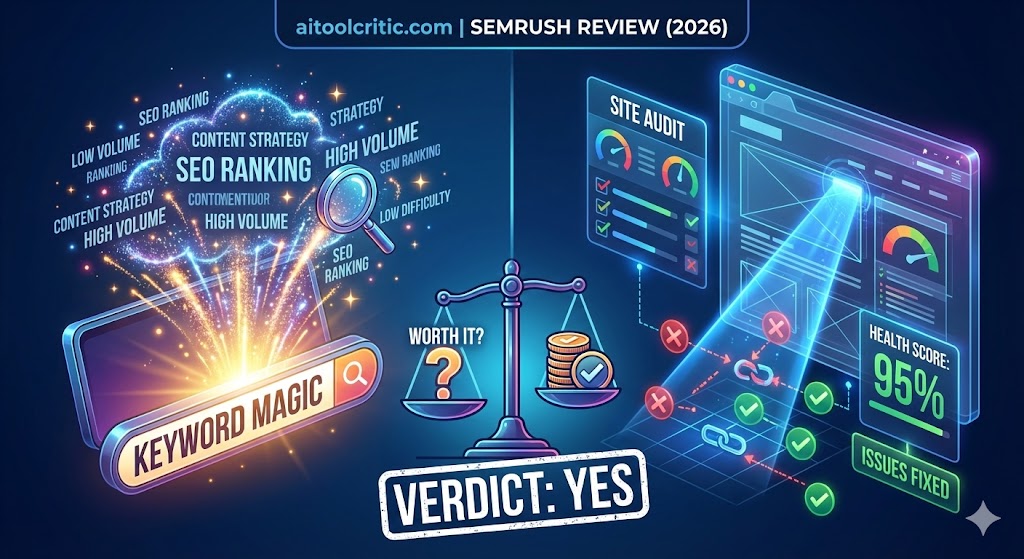
- The Keyword Magic Tool: This is the crown jewel. You type in one word, say “coffee,” and it spits out 200,000 variations, questions, and long-tail phrases. But the magic is the filters. You can find keywords that have high volume but low competition in seconds. It’s like panning for gold and finding a nugget every time.
- Site Audit: This tool crawls your site like a Google bot and screams at you about what’s broken. Broken links? Missing heavy H1 tags? Slow load speeds? It finds them all and gives you a to-do list to fix them. My site health score went from 60% to 92% in a week.
- Competitor Analysis (Domain Overview): This is where it gets spicy. You can plug in your biggest rival’s URL and see exactly where their traffic comes from. You can see their top pages, their top keywords, and who links to them. It feels illegal, but it’s awesome.
- Content Marketing Toolkit: This isn’t just about data; it helps you write. The SEO Writing Assistant plugs into Google Docs and grades your content in real-time, telling you if you’re overusing keywords or if your sentences are too hard to read.
Real-Life Wins: How I Actually Use It
Let’s talk about how this actually looks on a Tuesday morning when you’re trying to get work done. It’s not about staring at graphs; it’s about actionable wins.
- The “Low-Hanging Fruit” Strategy: I go to the Organic Research tool, filter my own site for keywords where I rank in positions #4–#10, and then I optimize those specific pages. It’s the easiest way to bump traffic without writing new content.
- The “Gap” Attack: I use the Keyword Gap tool to compare my site with two competitors. It shows me a list of keywords they rank for but I don’t. That is literally my content calendar for the next month. No brainstorming required.
- The Toxic Link Cleanup: Once a month, I run the Backlink Audit. It finds spammy links pointing to my site (which Google hates) and helps me disavow them. It keeps my site clean and in Google’s good graces.
What ‘Jobs’ Can You Hire Semrush For?
When you pay that subscription fee, you aren’t just buying software. You are effectively hiring a team of robots to do the heavy lifting for you.
- Hire it as your “Keyword Detective”: Its job is to scour the internet and find those hidden, high-traffic, low-competition keywords that your human brain would never think of.
- Hire it as your “Site Doctor”: Its job is to run diagnostics 24/7, alerting you the second a link breaks or a page starts loading too slowly, so you never lose ranking due to technical rot.
- Hire it as your “Corporate Spy”: Its job is to watch your competitors like a hawk, reporting back on their new ads, their new content, and their new backlinks so you can counter-attack immediately.
- Hire it as your “On-Page Coach”: Its job is to sit on your shoulder while you write, nagging you to add specific semantic keywords so you rank for the whole topic, not just one phrase.
My ‘Oh Crap, This Works’ Moment
I distinctly remember the moment Semrush won me over. I was trying to rank for a term related to “email marketing software.” It was a bloodbath. Huge companies owned the top 10 spots. I was ready to give up.
I threw the term into the Keyword Magic Tool, and I saw a “Question” filter. I clicked it. There, staring me in the face, was a specific, long-tail question with decent volume and a surprisingly low difficulty score. No one had written a dedicated guide for it. I wrote the article that afternoon, following the SEO Writing Assistant’s advice. Two weeks later? I wasn’t just on page 1; I was the Featured Snippet. My traffic jumped, and I finally stopped feeling like I was shouting into the void. That was the “Aha!” moment where the subscription paid for itself.
Let’s Talk Pros and Cons (No Fluff)
Look, nothing is perfect. Semrush is a beast, but it’s a complicated beast. Here is the honest breakdown of what I love and what drives me crazy.
The Good Stuff
- ✅ Data Accuracy is King: I’ve tested a lot of tools, and Semrush’s search volume and traffic estimates are consistently the closest to reality.
- ✅ The UI has Improved: It used to look like a spreadsheet exploded, but the new dashboard is much cleaner and easier to navigate.
- ✅ All-in-One Utility: I was able to cancel my separate rank tracker, my backlink checker, and my social media scheduler. It really does it all.
What I’d Change
- ❌ The Price Jump: The “Pro” plan is $139.95, which is okay, but if you want historical data or more projects, you have to jump to “Guru” at nearly $250. That’s a steep climb.
- ❌ Feature Overload: There are so many tools that you can easily get “analysis paralysis.” You need to focus, or you’ll spend all day looking at charts and zero time working.
Is Semrush Actually For You? (Be Honest)
- You, The Niche Site Builder: If you are building affiliate sites or blogs, this is mandatory. The keyword research alone will save you months of wasted effort.
- You, The Agency Owner: This is a no-brainer. The “My Reports” feature allows you to generate beautiful PDF reports for clients in seconds, making you look like a wizard.
However, we need to talk about where it fits in the content spectrum. While Semrush is an absolute monster for long-form SEO content and blog strategy, I wouldn’t necessarily “hire” it if my primary focus was purely social media buzz or short-form viral video scripts. It excels at data-driven, search-intent content. If you’re looking for a tool to just generate memes or manage a TikTok community, this is overkill with a capital O.
- But, You’ll Probably Hate It If…: You are a hobbyist blogger making $0. Spending $140/month when you aren’t monetizing is painful. Stick to free tools until you have revenue coming in.
Burning Questions You’re Probably Googling
I know you have questions because I had the exact same ones. Here is the quick-fire FAQ.
Yes, if you use it. If it helps you rank for just a few high-value keywords, the ROI is massive. If you just log in once a month, it’s a waste.
Sort of. They have a free account with very limited daily searches (like 10), and a 7-day or 14-day free trial for the Pro plan.
Semrush is generally better for an “all-in-one” marketing suite (PPC, Social, Content). Ahrefs is slightly better for pure backlink data.
It’s an estimate, but it’s widely considered one of the most accurate in the industry. It’s great for spotting trends, even if the exact number isn’t 100% perfect.
It’s their primary keyword research interface. It allows you to filter by questions, broad match, phrase match, and exact match to find the best terms.
Yes! They have a Listing Management tool that helps you manage your Google Business Profile and local citations.
They have “ContentShake AI” and the “SEO Writing Assistant” which help draft and optimize content, though it’s best used as a co-pilot, not an autopilot.
There is a learning curve because it’s so powerful. However, their “Semrush Academy” offers free courses that are actually really good.
The Guru plan (~$250/mo) adds historical data, more projects, and the Content Marketing Toolkit. It’s aimed at agencies and mid-sized businesses.
No, you can cancel anytime. If you are month-to-month, you just finish out your billing cycle.
The Final Verdict: Is It Worth Your Cash?
Here is the truth: You can do SEO without Semrush, just like you can dig a swimming pool with a spoon. It’s possible, but it’s going to take forever and you’ll probably be miserable. Semrush is the excavator. It speeds up the process, removes the guesswork, and gives you a roadmap to success that actually works. If you are serious about growing your traffic in 2025, stop guessing and get the data.
If Semrush Isn’t Your Vibe, Try These
Maybe the price is too high, or maybe you just want something simpler. I get it. Here are the top contenders that might fit your style better.
| Alternative | Rank | Rating | Best For | Key Feature Difference | Starting Price |
|---|---|---|---|---|---|
| Ahrefs | #1 | 4.8/5 | Backlink Geeks | If you live and die by backlinks, their index is arguably the cleanest in the game. | $129/mo (Lite) |
| SE Ranking | #2 | 4.7/5 | Agencies on a Budget | Flexible pricing based on how often you check rankings (daily vs weekly). Smart! | ~$55/mo |
| Ubersuggest | #3 | 4.3/5 | Beginners & Startups | They often offer a “Lifetime Deal,” which is wild in the subscription SaaS world. | ~$29/mo |
| Mangools | #4 | 4.6/5 | Design Lovers | The prettiest interface in SEO. It makes data actually look friendly. | ~$29.90/mo |
| Moz Pro | #5 | 4.5/5 | Traditional SEOs | If you love the “Domain Authority” (DA) metric, this is the source. | $99/mo |
