Bad AI character videos usually fail in one of two ways: either the tool is too limited, or the output gets weird fast.
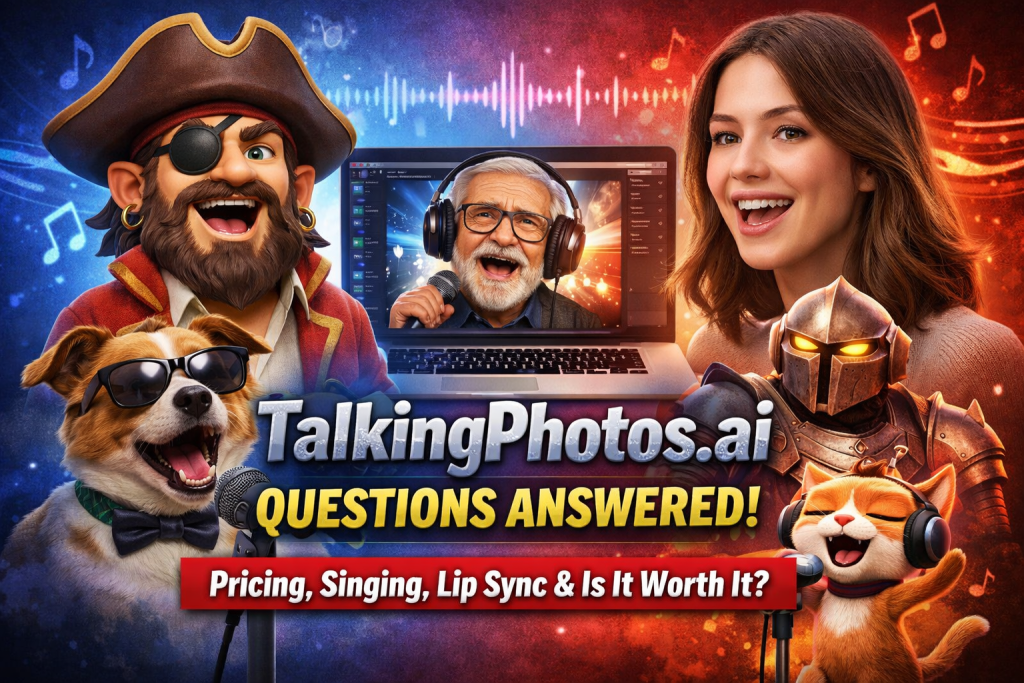
TalkingPhotos.ai is interesting because it is trying to solve both problems at once. It is built to turn photos into talking, singing, and motion-based videos, but it also leans into the stuff a lot of creator tools avoid: cartoons, animals, mascots, fantasy characters, and more playful content styles.
So the real question is not just “What does TalkingPhotos do?”
It is this:
Can TalkingPhotos.ai actually help you make usable content without trapping you in another monthly bill?
This guide is for creators, affiliate marketers, YouTubers, social media page owners, course builders, and beginners who want a real answer before buying. By the end, you will know what TalkingPhotos does well, where it can still get weird, what mistakes to avoid, and whether it fits your workflow.
Quick verdict
If you want a tool that can make talking character videos, singing clips, mascot videos, and creative social content without another recurring subscription hanging over your head, TalkingPhotos.ai is easy to see the appeal of.
It looks strongest when you use it for fast content creation, short-form videos, character-based ideas, and fun or attention-grabbing visuals.
It looks weaker when you expect ultra-perfect realism, endless fine control, or flawless motion every single time.
That is the honest version.
What is TalkingPhotos.ai, really?
In plain English, TalkingPhotos.ai is a photo-to-video creator.
You start with an image, then add text-to-speech, your own voice, uploaded audio, or song-style audio, and the platform animates the image into a video. Depending on the style you choose, that can mean talking videos, singing videos, motion-driven clips, mascot content, character videos, or social content built around a single image.
What makes it stand out a little more than the usual avatar tool is that it is not only about business presenters. It is clearly built for broader creator use, including cartoons, animals, fantasy-style visuals, and more playful content formats.
How is TalkingPhotos.ai different from most AI avatar tools?
A lot of AI avatar tools are basically trying to replace a spokesperson on camera.
TalkingPhotos feels more like a creative character engine.
That difference matters.
If you want polished office-style explainer videos, some avatar tools are built almost entirely around that. But if your content style is more visual, more playful, more weird, or more social-first, TalkingPhotos has a broader creative lane. That makes it more appealing for YouTube content, affiliate promos, mascot pages, education clips, storytelling, parody-style content, and quick attention-grabbing videos.
So this is less “corporate spokesperson machine” and more “turn this image into something alive enough to use in content.”
Is TalkingPhotos.ai one-time pricing or monthly?
This is one of the first reasons people look at it.
TalkingPhotos.ai is positioned as a one-time payment tool rather than a normal monthly subscription. That changes the buying decision right away because you are not asking yourself whether you will use it enough every month to keep justifying another bill.
Instead, the question becomes whether the current features are strong enough to make the upfront purchase worth it for your workflow.
If that is the part you care about most, the fastest move is to check the current TalkingPhotos.ai page here so you can compare what is included right now.
Are there hidden costs or upsells?
Here’s the smart way to think about this.
Do not buy any AI tool based on old screenshots, old reviews, or random comments in a Facebook group. Offers change. Plan names change. what is included changes. The right move is to read the current sales page carefully and buy based on what is shown right now.
TalkingPhotos is sold around the one-time pricing angle, and that is a big part of its appeal. But the best habit is still the same: check the current offer details directly before you buy.
What kind of creator is TalkingPhotos.ai best for?
This tool makes the most sense for people who want speed and variety more than frame-by-frame perfection.
Best for: content creators, affiliate marketers, educators, social media page owners, faceless channel builders, brand mascot projects, quick promo videos, and anyone who wants more than a plain talking-head avatar.
Probably not ideal for: people who need cinema-level realism, total editing precision, or polished human performance every single time without rerenders.
That is not a criticism. It is just the reality of where tools like this shine.
Can you upload your own photos and audio?
Yes, and that matters more than it sounds.
You are not limited to stock-looking assets. You can build videos around your own characters, your own images, your own branding, and your own voice tracks. That gives you a much better chance of making content that actually feels like yours instead of “generic AI person number 47.”
It also opens up more practical workflows. You can create content around a brand mascot, a themed character, a cartoon identity, a fantasy figure, or your own face if that fits your style.
The catch is that uploaded assets still need to be good. If your source image is low quality, badly cropped, poorly lit, or visually messy, the final output can go sideways fast.
Can you use your own voice with TalkingPhotos.ai?
Yes, and this is one of the more important practical features.
If your voiceovers already sound good before they reach the video tool, your finished videos usually feel a lot more believable. Good voice in, better video out. Robotic voice in, awkward result out.
That is why being able to use your own audio matters. It gives you more control over pacing, tone, and brand consistency.
If you already use cloned voice tools or generate your narration elsewhere, TalkingPhotos fits much better into a real creator workflow than a closed system that forces you to use only built-in voices.
Does TalkingPhotos.ai work for singing videos too?
Yes, and this is one of the reasons it stands out.
TalkingPhotos is not just pushing talking face videos. It also leans into singing-style content, which opens up a very different kind of use case. If you create music-adjacent content, parody videos, funny character videos, storytelling clips, or weird attention-grabbing reels, this feature is a real selling point.
Now let’s be real: singing AI content is one of those things that can look amazing when it works and deeply bizarre when it doesn’t. The concept is strong, but the quality still depends on the source image, the audio, and whether the style of motion actually matches the character you are trying to animate.
That does not make it a gimmick. It just means you want to use it strategically.
Can it do dancing and motion-based videos?
Yes, and that is another place where it feels more creator-focused than a basic avatar app.
But this is also where expectations matter the most.
Motion-based features are exciting, but they are also where little problems become obvious faster. If body movement gets repetitive, proportions look off, or motion feels unnatural, viewers notice fast. That is true for almost every tool in this category.
The best results usually come when you keep your idea within the range of what the tool can naturally handle instead of trying to force a giant, complicated performance out of a weak source image.
How good is the lip sync?
Lip sync is one of those features that people judge in about half a second.
If it is off, the video feels fake immediately. If it is close enough, most viewers go with it.
TalkingPhotos seems strongest when the audio is clean, the image is animation-friendly, and the clip is built around a reasonable level of movement. In that kind of setup, the output can be convincing enough for shorts, social posts, promo clips, and character-style content.
The mistake people make is expecting the tool to rescue weak inputs. If the audio pacing is sloppy or the image is a poor fit, even decent lip sync can still feel wrong.
How long can the videos be?
This is one of the biggest practical questions, because a lot of AI video tools sound more flexible than they really are until you hit the length limit.
TalkingPhotos supports short-form work well, and the higher plan gives you room for longer talking and singing clips. But here is the bigger truth: even when a tool supports longer clips, smart creators often still build in segments.
That gives you more control, better pacing, easier rerenders, and less pain when one scene comes out weird.
So even if your final piece is longer, do not assume the smartest workflow is one giant uninterrupted render.
Can you use TalkingPhotos.ai for commercial work?
Yes, but use your head.
Commercial use is one of the reasons people look at tools like this in the first place. They want to use them for affiliate content, lead-gen videos, promos, social ads, explainer clips, branded mascot content, and business content.
But “commercial use” does not mean copyright rules disappear because AI is involved. If you start leaning on celebrity likenesses, copyrighted characters, protected brands, or somebody else’s identity, you are creating risk you do not need.
The cleanest lane is still the best lane: your own brand, your own characters, your own images, your own ideas.
Is TalkingPhotos.ai beginner-friendly?
Yes, overall it looks beginner-friendly.
That does not mean every result is perfect on the first try. It means the idea behind the tool is easy to understand, and the workflow is much more approachable than traditional animation tools.
You do not need to be technical for this.
But you do need realistic expectations. Beginner-friendly does not mean “press one button and every video looks incredible.” It means you can get started quickly, learn by experimenting, and build better results as you understand what kind of images and audio the tool responds to best.
What mistakes should beginners avoid?
Mistake #1: expecting one tool to replace your entire creative stack. TalkingPhotos can do a lot, but it is still one tool in a workflow.
Mistake #2: feeding it bad inputs. If your source image is weak, your result is fighting uphill before the render even begins.
Mistake #3: trying to create one giant masterpiece in a single render. Shorter scenes are easier to control and easier to fix.
Mistake #4: expecting perfect realism when the tool is clearly strongest for fast, creative, visually interesting content.
Mistake #5: buying the smaller plan when you already know your workflow needs longer clips, stronger tools, and more flexibility.
Why does the output sometimes look weird?
This is probably the most useful question in the whole article.
If your output looks weird, it is usually because the input gave the AI too much to guess about.
That can mean a low-quality image, awkward angle, poor lighting, cluttered background, mismatched motion idea, or audio that already sounds unnatural before it even gets animated.
Here’s the exact way I do it: I start with the cleanest character image I can get, use audio that already sounds good on its own, and keep scenes tight enough that the AI does not have to hold a fragile illusion for too long.
That alone usually gives you a much better chance at something usable.
What do users seem to like most?
The strongest pattern is pretty easy to spot.
People like tools like this when they feel fast, easy, and flexible enough to create content they could not have made as quickly otherwise. TalkingPhotos seems to win most with users who care about speed, simplicity, and value more than surgical creative control.
That is why it keeps making sense for marketing clips, social storytelling, creative experiments, and content that benefits from personality more than perfection.
What do users seem to complain about most?
The complaints are also pretty predictable for this category.
Sometimes motion can feel repetitive. Sometimes realism is not quite there. Sometimes lip sync is close but not perfect. Sometimes control options feel limited compared to more expensive tools. Sometimes longer workflows need more patience than people expected.
None of that makes the tool bad. It just tells you where the edges are.
And honestly, that is the kind of information you want before buying, because it helps you decide whether those tradeoffs matter for your content style.
Is there a refund policy?
This matters more than a flashy demo.
A refund window gives you room to test the tool on your actual workflow instead of just hoping the homepage examples match what you want to make.
That is the best way to think about it. Do not ask whether the marketing looks exciting. Ask whether you have enough room to test your exact use case safely.
If your plan is to make mascot videos, talking character clips, singing content, or attention-grabbing promo videos, that is the real decision point.
Is TalkingPhotos.ai worth it?
For the right kind of creator, yes.
If your goal is to make talking character videos, singing clips, creative short-form content, mascot videos, or branded visual content without adding another recurring monthly cost, TalkingPhotos.ai is easy to justify.
If your standard is “this must look indistinguishable from real footage every single time,” you will probably hit the limits faster.
So the honest verdict is this:
TalkingPhotos.ai looks strongest for creators who want speed, flexibility, variety, and a one-time-payment model.
It looks less ideal for buyers who need maximum realism and maximum control above everything else.
If that sounds like your lane, you can check the current deal here: TalkingPhotos.ai.
Final verdict
Okay, let’s have a real talk.
TalkingPhotos.ai is not impressive because it is perfect. It is impressive because it gives creators a broad, fun, usable way to turn images into content without the usual monthly-tool fatigue.
That is the sweet spot.
If you want quick, creative, attention-grabbing videos and you understand that AI output still needs smart inputs, this is the kind of tool that can absolutely earn a place in your workflow.
If you want a safer look at the current offer before deciding, check it here: TalkingPhotos.ai.
