
Okay, so you hear “AI” thrown around EVERYWHERE, right? It sounds super complicated, but I promise, it’s not! It’s actually fascinating stuff, and you’re already using it every single day.
Forget the crazy killer robots from the movies for a second. Let’s break down the REAL types of AI that exist (and the ones we’re dreaming about). Let’s go!
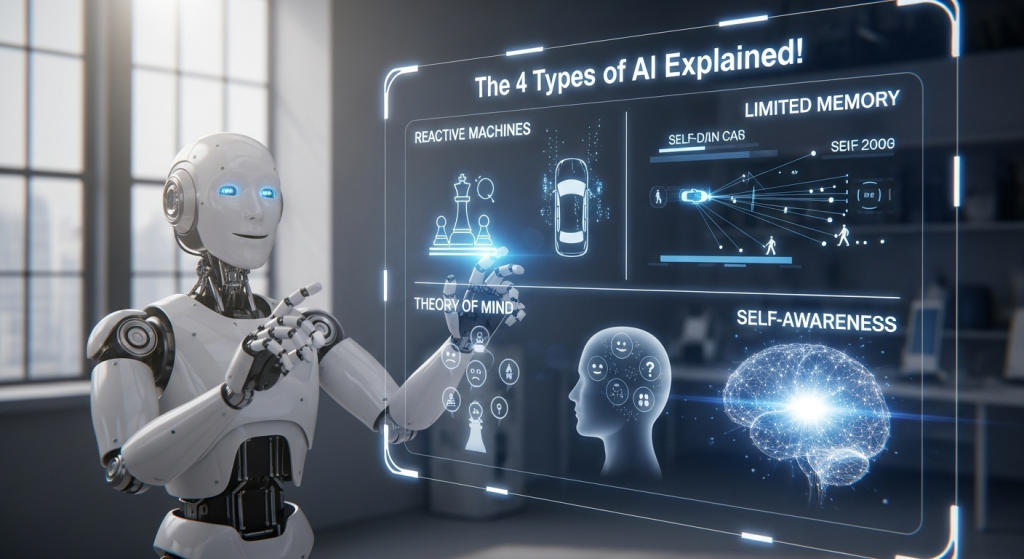
1. Reactive Machines (The OG AI)
Alright, this is the most basic, level-one AI. Think of it like a machine with zero memory. It can’t learn from the past; it just sees what’s happening RIGHT NOW and reacts. That’s literally it!
The perfect example is IBM's Deep Blue, the chess computer that beat a grandmaster. It wasn’t “thinking” about its last game or your play style. It was just analyzing the board in that exact moment and picking the absolute best move. Simple, but powerful!
So, what’s their deal?
- No Memory whatsoever: What happened a second ago? Doesn’t know, doesn’t care.
- One-Trick Ponies: They do one specific thing and that’s all.
- Totally Predictable: They just follow their programming, no surprises!
2. Limited Memory (The AI We Use Now!)
Now we’re leveling up! This is the kind of AI that powers most of the cool stuff we use. It’s all thanks to the magic of machine learning and deep learning, where an AI can be trained on past data. It has a short-term memory, which makes a HUGE difference.
Think about a self-driving car. It doesn’t just see a pedestrian in front of it. It remembers, “that person was walking at 3 mph in this direction,” so it can predict where they’ll be in the next few seconds. The same goes for your phone’s virtual assistant and the helpful chatbots you see on websites; they remember the last thing you said to keep the conversation going.
What makes them cool?
- Short-Term Memory: They can hold on to recent info to see what’s up.
- They Actually Learn: Through machine learning, they can be trained on tons of data to get smarter.
- Way Better Decisions: They have context, which means they’re not just reacting blindly.
3. Theory of Mind (The Sci-Fi Future!)
Okay, hold on, because this is where it gets WILD. This type of AI doesn’t exist yet, but it’s what researchers are working towards. This is an AI that could understand that people have thoughts, feelings, and intentions. This goes way beyond the classic Turing Test proposed by pioneer Alan Turing, which just tested if a machine could trick a person into thinking it was also human.
Can you IMAGINE a virtual assistant that knows you’re having a bad day just from the sound of your voice and asks if you want to hear your favorite playlist? It’s AI with empathy! It could totally change things like mental healthcare and education by understanding our human “vibe.”
What’s the dream?
- Emotional Intelligence: It gets that you’re happy, sad, or frustrated.
- Amazing Social Skills: It could chat with you like a real friend.
- Real Empathy: It wouldn’t just know you’re sad; it would understand why.
4. Self-Awareness (The Final Boss of AI)
And for the grand finale… self-aware AI. This is pure science fiction right now, so don’t worry about the robot apocalypse just yet! This is the idea of an AI that has its own consciousness, its own sense of self, and is basically its own being.
This is the stuff of movies—an AI that could think, “Who am I? What is my purpose?” and have its own feelings and independent thoughts. We are SO far from this, it’s not even funny. But wow, it’s exciting to think about what it could mean for humanity one day!
The ultimate goal:
- Consciousness: It’s “awake” and aware of itself and the world.
- Sentience: It can actually FEEL things, like joy or pain.
- Independent Thought: It can form its own ideas without us. Yikes… and cool!
Frequently Asked Questions
What is the most common type of AI today?
You're using it constantly! The vast majority of AI in the world today is Limited Memory AI. This includes everything from the Netflix algorithm that suggests what to watch next to the AI writing assistant that helps you draft emails.
What's the difference between AI and Machine Learning?
Great question! Think of Artificial Intelligence (AI) as the huge, overall goal of creating smart machines that can perform human-like tasks. Machine Learning (ML) is one of the most important methods used to achieve AI. It’s the process of “training” a computer with tons of data so it can learn and make predictions without being explicitly programmed for every single task.
